
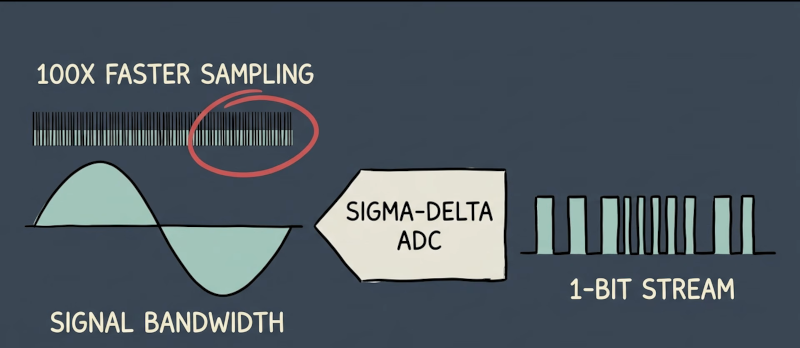
An old algebra teacher used to say, “You have to take what you know and use it to get what you don’t know.” You might say the same thing about converting analog signals into digital. Computers know how to count and keep time. [Eric Explains] has a video purporting to explain “every type of analog-to-digital converter.” We aren’t sure he got every possible method, but there’s still a lot of information in the video, which you can see below.
From the flash ADC, using a ton of comparators to the successive approximation converter, which essentially plays a game of hi/lo, guessing the answer and figuring out if the real answer is higher or lower.
Those are pretty common, but the video also covers things like the Wilkinson ADC and other more exotic techniques. Each method, of course, has its advantages and disadvantages. For example, the flash ADC is fast, but requires a lot of components and power.
Sometimes, the method you use depends on how you are building. For example, you probably wouldn’t use a charge system on a breadboard since precision capacitors are finicky. But on an integrated circuit, capacitors made with photolithography may not be very precise, but the ratio between capacitors is super precise, making that a common technique in that domain.
Even if you never need to design your own converter, understanding the different architectures will let you make a better selection among alternatives. Then again, you can design your own. We’ve seen most of these architectures in past projects.
Source: Blog – Hackaday